


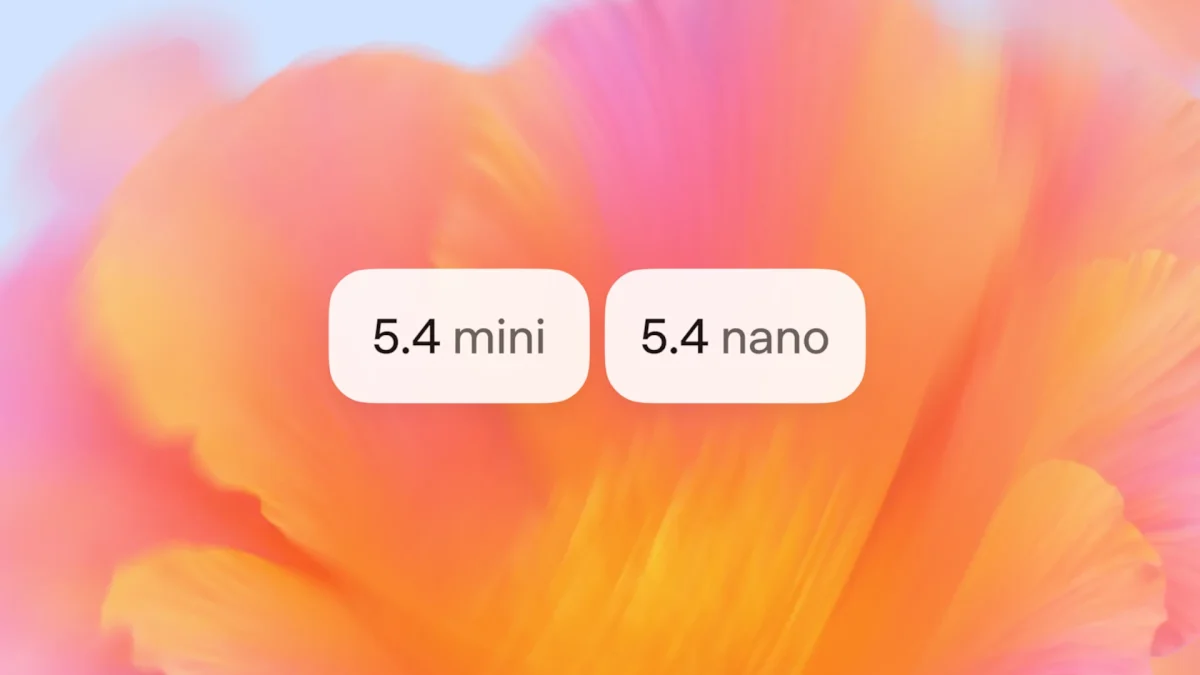

OpenAI has expanded its family of models with the launch of GPT-5.4mini and GPT-5.4 nanotwo compact versions aimed at speed and efficiency. The most relevant news for the common user is that GPT-5.4 mini is now available in the free and Go levels of ChatGPT, accessible from the option «Thinking» from the menu.
The company claims that the model outperforms the previous GPT-5 mini in coding, reasoning and multimodal understanding, and that it works more than twice as fast. For paying subscribers, it will work as an alternative when exhaust the full GPT-5.4 usage limit. In the API, the price is $0.75 per million input tokens, with a context window of 400,000 tokens.
GPT-5.4 nano: the smallest model, only for developers
We're introducing GPT-5.4 mini and nano, our most capable small models yet.
GPT-5.4 mini is more than 2x faster than GPT-5 mini. Optimized for coding, computer use, multimodal understanding, and subagents.
For lighter-weight tasks, GPT-5.4 nano is our smallest and cheapest… pic.twitter.com/cdp5HWtM2M
— OpenAI Developers (@OpenAIDevs) March 17, 2026
The GPT-5.4 nano, for its part, does not reach ChatGPT or Codex: It is only available via API. OpenAI recommends it for specific tasks—classification, data extraction, code agent subtasks that don't require complex reasoning—and has set it to $0.20 per million entry tokensthinking about high-volume projects where latency outweighs response depth.
There has also been movement recently at Anthropic. The company has updated Claude with the ability to generate graphs, diagrams, and interactive visualizations directly in the conversation, without the user having to request it: the model evaluates the context and decides if a visual enriches the explanation. The feature is in beta and available to all users, including free accounts.
Do you think that free AIs are already capable enough, or does the leap in quality of paid plans still justify the monthly outlay?