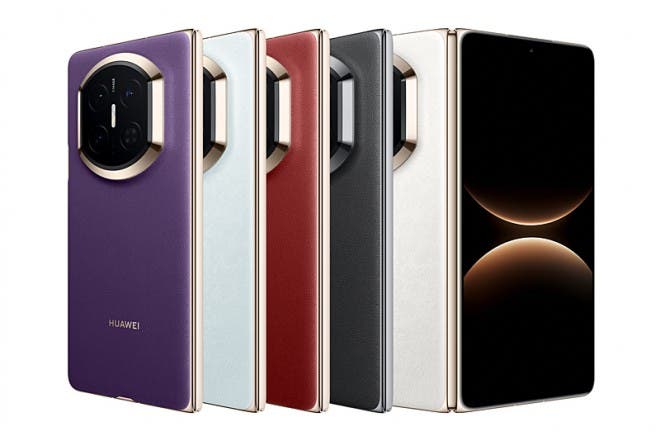
Huawei continues to press the accelerator on foldables with the new Huawei Matenow official in China as the successor to the Mate X6. The new model grows slightly in screen size, debuts the Kirin 9030 Pro chip and, above all, it is committed to a larger battery and resistance to water and dust that is unusual in this type of mobile.
The Mate X7 arrives with double certification IP58 and IP59something that we do not normally see in Samsung foldings or in Google's bets, and maintains a very thin book-type design, only 4.5 millimeters thick when open and about 235 grams in weight. All this, together with the functions of HarmonyOS 6 and the 50 megapixel rear camera with variable aperture, reinforces Huawei's intention to leave behind the 'delicate mobile' image associated with foldables.
Larger screens and less fear of getting the foldable wet
On the outside, the Huawei Mate X7 offers an external screen 6.49 inch LTPO OLEDwith a resolution of 2444 x 1080 pixels, a refresh rate of 120 hertz and a maximum brightness of up to 3000 nits. Inside, the folding screen reaches 8 inches (2416 x 2210 pixels), also LTPO at 120 hertz, with 1440 hertz PWM dimming to reduce flicker and make it somewhat more comfortable to look at in prolonged use.
The chassis has been refined compared to the Mate The brand also boasts a reinforced internal laminate and a second generation Kunlun crystal on the external screen, designed to improve resistance to falls and scratches, something especially important in a mobile phone that opens and closes all the time.
The most striking part is in the resistance: the Mate X7 boasts of IP58 and IP59which involves protection against dust and water, including high-pressure water jets and hot water tests that Huawei has shown in its own videos. It is not a mobile phone with which to dive happily, but it should withstand heavy rain, constant splashes or a very dusty environment without drama, which is exactly where folding devices are most vulnerable.
Kirin 9030 Pro, more battery and versions with up to 20 GB of RAM
Inside, the Huawei Mate X7 mounts the new Kirin 9030 Proa nine-core chipset manufactured at 7 nanometers that improves the Kirin 9020 of the Mate X6 in multi-core performance and efficiency. The first performance data places it in a similar league to the latest mid-high-range Snapdragons, with a plus in performance tasks. AI and computational photography thanks to Huawei's own NPU and integration with HarmonyOS 6.
The memories also go up a level: the standard model remains in versions of 12 GB and 16 GB of RAM with up to 1 TB of storage, while the collector's edition goes up to 20GB RAM and 1 TB of storage. It is an amount of memory that may sound exaggerated, but for those who live with many parallel apps, floating windows and heavy games, it is more appreciated than it seems on paper.
The battery is another important leap compared to the Mate X6. Here Huawei is betting on a up to 5600 mAh silicon-carbon batterycompatible with fast charging 66W wired and 50W wireless fast charging. Some technical sheets speak of 5525 mAh or even 5110 mAh, but most sources and Huawei itself place the figure around 5600 mAh depending on the version, so we can assume a clear increase compared to the 5110 mAh of the previous model. In the end, beyond the figures, the important thing is that it offers sufficient autonomy for intensive use without the need to constantly check the battery level.
50 megapixel cameras and prices of the Huawei Mate X7 in China
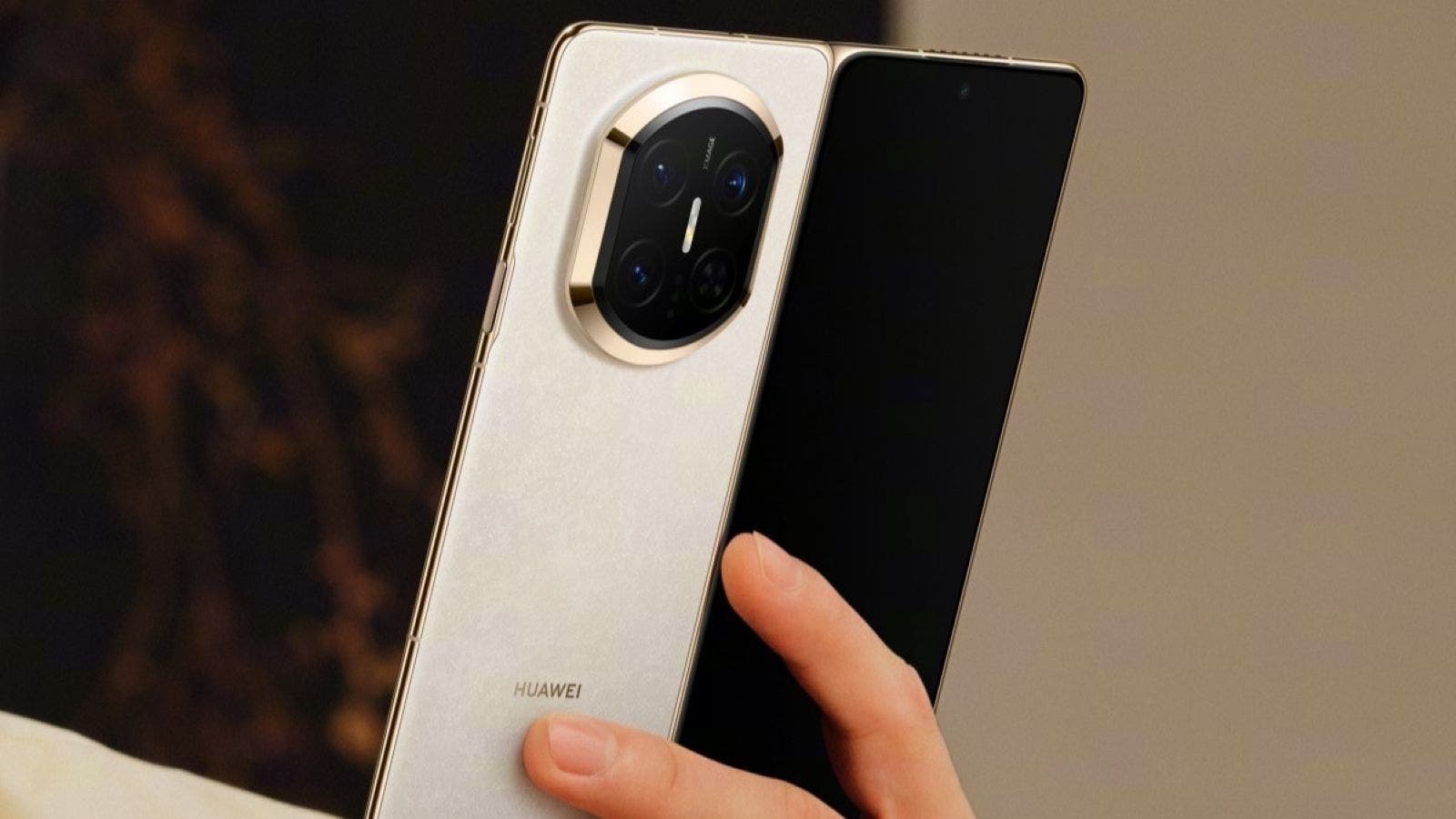
In photography, the Mate X7 opts for a redesigned rear module with three high resolution cameras. The 50-megapixel main sensor includes variable aperture and optical stabilization, allowing you to adapt the blur and light input depending on the scene. It is accompanied by a 40-megapixel ultra-wide-angle lens and a 50-megapixel periscopic telephoto lens with 3.5x optical zoom and up to 100x digital magnification, as well as close-range macro modes.
Huawei maintains its commitment to sensors RYYBwhich replace traditional RGGB color filters to capture more light, especially at night. In practice, we should see improvements in low-light photos and in scenes with a lot of contrast, where Huawei's processing usually comes into its own. For selfies, the Mate
Regarding prices, the Huawei Mate X7 starts in China from 12,999 yuan for the version with 12 GB of RAM and 256 GB of storage, which at the current exchange rate are about 1,590 euros. The variant with 12 GB and 512 GB goes up to 13,999 yuan (around 1,710 euros), while the Collector's Edition starts at 14,999 yuan (about 1,830 euros) with 16 GB of RAM and 512 GB of storage and goes up to 15,999 yuan (about 1,955 euros) with 16 GB of RAM and 1 TB of storage. ANDThe highest model in the rangewith 20 GB of RAM and 1 TB of storagestands at 17,599 yuan, which is around 2,150 euros.
For now, the launch is confirmed for China only and with sales expected at the beginning of December, without news of international expansion. Looking at the brand's recent history, it seems difficult for the Huawei Mate
A very complete folding that we may never see in Spain
The Huawei Mate X7 reinforces the idea that foldables are no longer just a fragile and expensive whim. Between the bigger batterydouble certification IP58 and IP59the new Kirin 9030 Pro and options with up to 20 GB of RAM. Huawei has achieved a very balanced folding on paper, which also maintains a relatively light and thin design.
It seems that with this new proposal the firm will continue to lead the folding phone market, something that could become a headache for Samsung and other brands. But the great unknown remains the same as always: availability and ecosystem. As long as the Mate limited to curiosity and import with many concessions. But if one day a foldable like this officially arrives with full support for our apps, would you consider giving a foldable Huawei a chance as your main mobile phone?