


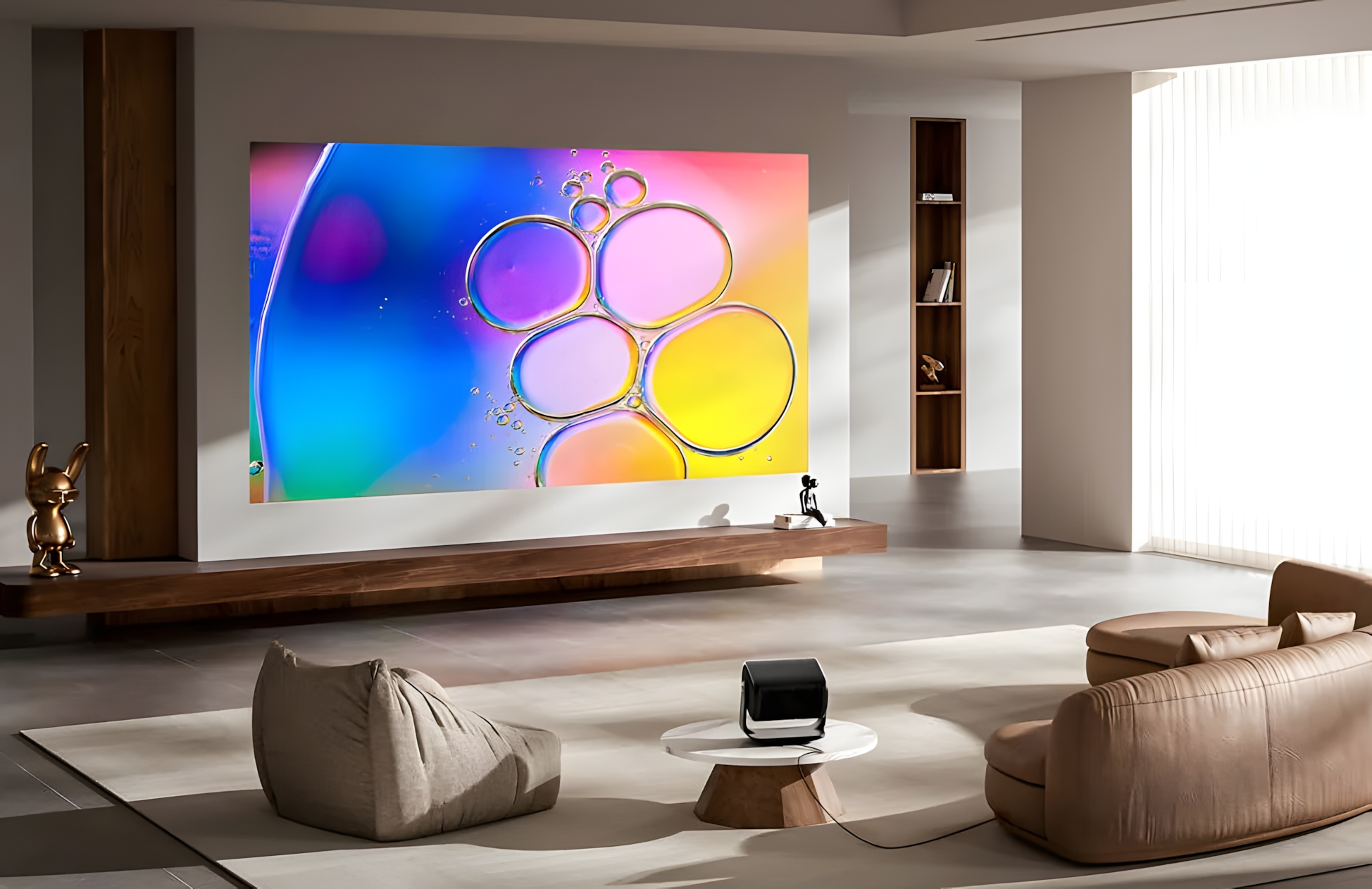

With its hybrid technology and announced high brightness, the Dangbei MP1 Max aims to establish itself as the new heavyweight in home cinema, combining a brilliant 4K image, ultra-flexible installation, and a connected experience with Google TV. Here’s our full review.
The Dangbei MP1 Max was unveiled at CES 2025. It’s positioned as a more premium model than the DBOX02 we recently reviewed. It features hybrid lighting technology, combining a triple laser with LEDs, to deliver a 4K image with precision and brightness rarely achieved in this price range. With its 3100 ISO lumens, according to the brand, it aims to deliver brilliant projection, even in partially lit rooms, while ensuring exceptional color fidelity thanks to particularly wide coverage of the BT.2020 space and very rigorous factory calibration.
Designed to fit easily into any interior, the MP1 Max boasts a compact and ingenious design. Its rotating chassis allows it to rotate 360 degrees and tilt 135 degrees vertically, making it possible to project onto a wall, ceiling, or even the floor, without any other accessories. This flexibility is accompanied by advanced automation: focusing, keystone correction, and adaptation to ambient light are managed in real time by the onboard artificial intelligence, greatly simplifying the user’s life.
On the multimedia side, the Dangbei MP1 Max features Google TV, providing access to all popular streaming platforms (Netflix, Prime Video, Disney+, YouTube, etc.) and voice control via Google Assistant. Its comprehensive connectivity (HDMI 2.1, USB 3.0, Wi-Fi 6, Bluetooth 5.2) makes it compatible with most game consoles, soundbars, and other modern peripherals. Audio is not forgotten, with two 12W speakers and a sound chamber optimized for deep bass and clear reproduction, even at high volumes.
The MP1 Max is aimed at both demanding moviegoers and families looking for a versatile and easy-to-use solution that can transform any room into a real screening room. It competes with the Xgimi Horizon Ultra, JMGO N1S Ultra, and Hisense C2 Ultra or C2 Pro, with which it shares aesthetics and some technologies. It also competes with the Nebula X1, for example. But what exactly is it worth? We tested it so you can form your own opinion.
Dangbei MP1 Max Technical Sheet
| Model | Dangbei MP1 Max |
|---|---|
| Dimensions | 296 mm x 246.7 mm x 230 mm |
| Maximum definition | 3840 x 2160 pixels |
| Screen size | 300 inches |
| HDR compatible | HDR10, HDR10+ |
| HDMI ports | 2 |
| Surround compatible | DTS-HD, DTS-X |
| Number of speakers | 2 |
| Speaker power | 24 watts |
| Audio output | Headphones, Speakers |
| Operating System (OS) | Google TV |
| Voice assistant | Google Assistant |
The Dangbei MP1 Max projector we tested was loaned to us by the brand. It was tested in conjunction with a Lumene Movie Palace UHD Platinum 300C screen. The measurements were taken with suitable professional equipment and in front of the screen in order to limit errors and to provide values that match what the viewer can actually see
Design, a swinging video projector
Dangbei MP1 Max
Like the Hisense C2 Pro (and its Ultra and C2 “standard” versions) as well as the Dangbei DXBOX02 Pro, the Dangbei MP1 Max is installed on a swing. In addition, it adopts a modern and refined aesthetic, in line with recent lifestyle projectors. Its chassis is compact and its lines are rather rounded, easily integrating into a contemporary living room. We appreciate its matte finish, which limits fingerprints and unwanted reflections.

One of the major advantages of this model is therefore the presence of an integrated support, capable of tilting the device 135 degrees and rotating it 360 degrees, thus allowing it to project on a wall as well as on the ceiling or even the floor.


This flexibility greatly simplifies installation, which we’ll come back to a little later, and opens up new possibilities for use, particularly for families or fans of big-screen gaming. Just in case, underneath, there’s a screw thread to secure the device to a suitable support.

On the front, there is of course, the slightly recessed lens and the sensors allowing the image to be optimized automatically.
The vents are discreetly integrated on the sides (with a beautiful fabric covering) and at the back, ensuring good air circulation without compromising the overall aesthetic. The whole thing exudes robustness, with careful assembly and no play in the moving parts. While the MP1 Max doesn’t revolutionize the genre, it stands out as an elegant piece of technology, designed to be displayed without embarrassment in the living room.

The projector comes with a large power supply. This is something to consider when traveling.

Connectors
Dangbei MP1 Max
The MP1 Max offers a comprehensive connectivity package that lives up to its ambitions. On the back, there are two HDMI inputs, one of which is eARC-compatible for easy audio return to a soundbar or amplifier, as well as a USB 3.0 port for direct playback of multimedia content from a key or external hard drive. A mini-jack analog audio output allows you to connect headphones or a sound system, if necessary.

Wi-Fi 6 and Bluetooth 5.2 ensure a fast and stable wireless connection, whether for streaming or connecting accessories. The RJ45 Ethernet port allows for a wired connection, ideal for ensuring consistent throughput when streaming 4K HDR content. All connections are easily accessible, even when the projector is placed against a wall, thanks to a clever layout and the ability to rotate the device on its stand.
The power cable plugs into the base and therefore swivels with the device, if necessary.

The remote control
The remote control that comes with the Dangbei MP1 Max is compact. It’s no secret that it’s the same remote that comes with the DBOX02. It feels great in the hand. The buttons are well spaced to prevent misoperation, and the whole thing feels solid.

We particularly appreciate the presence of direct shortcuts to the main streaming platforms such as YouTube, Netflix and Prime Video. There is also a dedicated button for image and sound settings, allowing you to quickly adjust settings without having to navigate through menus.
The remote works via Bluetooth, which eliminates the need to point it precisely at the projector, and it includes a microphone for voice commands via Google TV. However, the lack of backlighting can be a problem when using it in the dark, which is a regrettable detail. It is powered by conventional batteries.
The screen
Dangbei MP1 Max
The Dangbei MP1 Max projector comes without a screen, belonging to the long-throw home cinema projector range. This leaves you with a choice, but if your budget is limited, you might also be tempted to install it without a screen, using a wall as a projection surface and thus losing the relatively important benefit of having a surface optimized for projection. Expect to pay between approximately 500 and 2700 euros for screens of various sizes whose surface benefits from a specific treatment.
Facility
Dangbei MP1 Max
Installing the MP1 Max is easy, and it is even for inexperienced users. Thanks to its stand, simply place it on a table or piece of furniture, then adjust the projection angle according to the chosen surface.
The InstanPro AI 2.0 system then takes over: focusing and keystone correction are performed automatically and in real time, detecting obstacles and adapting the image so that it remains perfectly rectangular and sharp. This automation saves precious time and limits the risk of error, particularly during temporary installation or mobile use.

Note that it is possible to launch a mode that automatically adapts to the screen size. If you have a screen with fairly wide edges, the device recognizes them in a few seconds and adjusts the diagonal and sharpness in an instant.
Of course, in addition to the automatic settings, it is possible to take control of the settings to make optimizations if necessary. However, in our testing phase, we were completely satisfied with the automatic configuration.
The entire process, from unboxing to first projection, takes only a few minutes, making it a particularly user-friendly device.
To get a 100-inch diagonal image, you need to stand back about 2.80 m. For a basic 3 m image, we needed to stand back about 3.90 m. If you place the projector 1.5 m from the wall or screen, you get an image that is about 147 cm diagonal.
Dangbei MP1 MaxThe image in subjective mode
The Dangbei MP1 Max relies on hybrid technology combining tri-laser and LED, a choice that allows it to offer an impressive brightness of 3100 ISO lumens, according to the brand, while guaranteeing highly accurate colorimetry. On paper, this is much more than the Dangbei DBOX02 (2450 lumens), the Xgimi Horizon Ultra (2300 lumens), the Hisense C2 Pro (2600 lumens) and even the Hisense C2 Ultra (3000 lumens). Only the Nebula X1 does better with its 3500 lumens, according to the brand.
The MP1 Max features a 0.47″ DLP DMD chip, coupled with pixel shifting technology, delivering a remarkably precise 4K Ultra HD image, where every detail stands out, even on very large diagonals.

The MP1 Max offers several picture modes, suitable for all uses: Standard, Vivid, Cinema, Game, User (customizable) and an Eco mode to reduce brightness and noise. Each mode adjusts the colorimetry, contrast and color temperature settings, allowing the user to find the ideal balance according to the ambiance or type of content. Fans of fine-tuning will appreciate the ability to customize the User mode to get the most out of the projector.
In terms of HDR compatibility, the Dangbei MP1 Max supports HDR10, HDR10+, and HLG formats, allowing it to deliver high dynamic range content with excellent control. While Dolby Vision isn’t on the menu, HDR10+ support and its dynamic metadata are enough to deliver a convincing performance for compatible movies and TV shows. Note, by the way, its compatibility with 3D content.
In use, the MP1 Max’s luminous power translates into a brilliant image, even in a partially lit room. Whites remain pure, colors don’t wash out, and even in broad daylight, the show remains on point. The contrast is surprising in its ability to reproduce deep blacks and subtle gradations in the shadows. When projecting dark sequences, the projector manages to reveal many details in dark areas, without any “mush” effect or loss of information. The separation between the different shades of black remains perceptible, especially on HDR10+ content.
Color reproduction is one of the MP1 Max’s strong points. In documentaries like Our Planet (Netflix, HDR), the color palette is fully expressed: the greens of the forests, the deep blues of the oceans, and the reds of sunsets appear vibrant, without ever falling into artificiality. Skin tones remain accurate, even in brightly lit or backlit scenes. Be careful, however, because the factory settings offer sequences that can appear a little too saturated in terms of colorimetry.
Dynamic and bright scenes also benefit from careful handling. On a film with many fast-moving sequences, we benefit from MEMC motion compensation, which smooths out the action without generating artifacts or jerks. Watching F1 races is very enjoyable with this model.
Testing different content, the Dangbei MP1 Max confirms its versatility. However, it should be noted that the Standard and Cinema image modes can sometimes lack precision for the most demanding users; switching to User mode and a personalized calibration will allow you to exploit the full potential of the device.
Movement compensation
As mentioned, the MP1 Max incorporates MEMC technology, which can be activated or deactivated depending on your preferences. During action or sports scenes, motion compensation proves effective, providing appreciable fluidity without generating major artifacts. However, some sensitive users may prefer to deactivate this function to avoid the “soap opera” effect that is sometimes considered too artificial. The adjustment options allow you to adjust the level of MEMC intervention, thus offering a compromise between naturalness and fluidity. Overall, the processing remains discreet and does not affect the readability of the image, even during the fastest sequences.
The rainbow effect
Like any DLP projector, the MP1 Max isn’t entirely immune to the rainbow effect, a visual phenomenon that manifests itself as brief flashes of color on moving bright objects against a dark background. However, the hybrid LED-laser technology used here significantly limits this defect compared to traditional RGB laser models. During testing, the effect proved very subtle, even on white subtitles or during high-contrast scenes. Most viewers won’t notice it, but the most sensitive viewers may still be able to notice it occasionally. Overall, the MP1 Max performs better than the average in its category in this regard.
Dangbei MP1 MaxThe measurements, probes in support
Remember that the measurements, as with all tests carried out on Frandroid, are made using default settings. The MP1 Max offers a native contrast ratio of 770:1, which is correct, but not optimal. This is significantly less than the Valerion VisionMaster Pro 2, for example.
Regarding color fidelity with SDR content, we obtained an average Delta E of 8.18 in Cinema mode. This measurement is significantly higher than the threshold of 3 below which the human eye can no longer differentiate between the requested color and the one displayed. There are, therefore, optimizations to be made. Concretely, to the eye, this results in colors that are too saturated.
For the average color temperature, the factory settings offer a measurement of 7000 K, which is also higher than the target value of 6500 K. The colors drift too much. The gamma is relatively well managed with an average of 2.14.
For HDR content, Cinema mode also provides the best rendering. However, here too, the default settings are not fully satisfactory, and the most demanding users will have to calibrate the device to get the best results. Thus, we measured an average Delta E of 8.03, once again above the threshold of 3.
Regarding maximum brightness, still with the Cinema, we measured a peak brightness of 221 cd/m² for an image measuring 100 inches diagonally against 219 cd/m² for the Nebula X1, 265 cd/m² for the Valerion VisionMaster Pro 2 and 257 cd/m² for the Hisense C2 Pro.
For an image that is 3 meters wide, the projector offers a brightness of 90 cd/m², which remains relatively bright for such a size.
Finally, regarding the coverage of the DCI-P3 and BT2020 color spaces, we obtained respective values of 88.97% and 70.08%, which is correct, but well below the measurements obtained on the Valerion VisionMaster Pro 2, one of the references in this field.
Gaming is totally playable
Dangbei MP1 Max
While Dangbei touts the MP1 Max as a versatile projector that can be used for both cinema and gaming, its gaming performance deserves a more nuanced analysis. From a technical standpoint, the MP1 Max features HDMI 2.1 ports, 4K 60Hz compatibility, and a display mode that can reach 240Hz in Full HD, opening the door to a smooth gaming experience, especially on PCs or the latest generation of consoles.
In addition, the high frequency allows for a good feeling of movement, especially in fast-paced games such as FPS or racing games, and the image projected on the big screen offers a spectacular immersion where the size of the image and the vividness of the colors enhance the gaming pleasure.
However, the question of responsiveness, essential for demanding gamers, reveals some limitations. Indeed, the input lag measurement allowed us to reveal a display delay time of 35 ms in 4K at 60 Hz, which remains acceptable for casual gaming or less competitive titles, but proves too high for fans of games where every millisecond counts, such as competitive FPS or fighting games.

In practice, on platform games, single-player adventures, or family titles, the MP1 Max’s responsiveness remains largely sufficient, and the gaming experience fully benefits from the image quality and display size. On racing games, the image fluidity and movement management are convincing, with no noticeable dragging or stuttering, and the pleasure of a game on a giant screen takes on its full meaning. On the other hand, for competitive gamers or those who prioritize pure performance, there are more suitable alternatives on the market.
Dangbei MP1 MaxAudio, good power and warm sound
Under its chassis, there are two 12-watt speakers, powered by a Texas Instruments TAS5805 amplifier, and supported by a 750 cm³ acoustic chamber capable of going down to 45 Hz. This device allows the MP1 Max to deliver a surprisingly full and dynamic sound, with present bass and clear reproduction of dialogue, even at high volume.
From the very first minutes of viewing, the sound reproduction surprises with its power and balance. The voices remain perfectly intelligible, without being drowned out by effects or music, and the bass adds welcome depth during action scenes or orchestral soundtracks.
The MP1 Max goes further by supporting the main immersive audio formats on the market, including Dolby Audio, DTS Virtual:X, DTS-HD, Dolby Digital and Dolby Digital Plus.
For users wishing to connect more powerful audio equipment, the presence of an HDMI eARC output and a 3.5 mm headphone jack facilitates its integration into an existing installation.
Dangbei MP1 MaxThe interface
The MP1 Max features Google TV, providing a seamless, content-rich user experience. Upon powering it on, the interface offers a quick-access banner for the main streaming apps: Netflix, Disney+, Prime Video, YouTube, Canal+, and many more. Navigation is intuitive, with personalized suggestions that become more refined over time.
The settings menus are clear and provide quick access to advanced settings, whether it’s image calibration, sound management, or connectivity options. Chromecast integration makes it easy to stream content from a smartphone or tablet, and Google Assistant compatibility allows you to control the projector by voice.
The interface is very responsive. No slowdowns were observed during testing, even when switching between applications or playing 4K HDR content.
Additionally, the Google Play app store offers a wide selection of programs, from games to productivity tools, enhancing the MP1 Max’s versatility. Finally, multi-user management allows each member of the household to find their preferences and recommendations, a real plus for family use.
Dangbei MP1 MaxConsumption and noise pollution
The MP1 Max boasts reasonable power consumption for a projector of this power, averaging 190W in normal use according to manufacturer data. Thermal management is efficient: the fan remains discreet, with a noise level measured at less than 30dB at one meter in most situations, making it inaudible when watching a film or series.
Only a slight increase in power is noticeable during prolonged use at full power, but this does not affect the comfort of use. The device does not heat up excessively, and the well-designed ventilation prevents any risk of overheating.
Dangbei MP1 MaxPrice and release date
The Dangbei MP1 Max has been available in Europe since spring 2025, at a price of around 2000 euros depending on the retailer.