


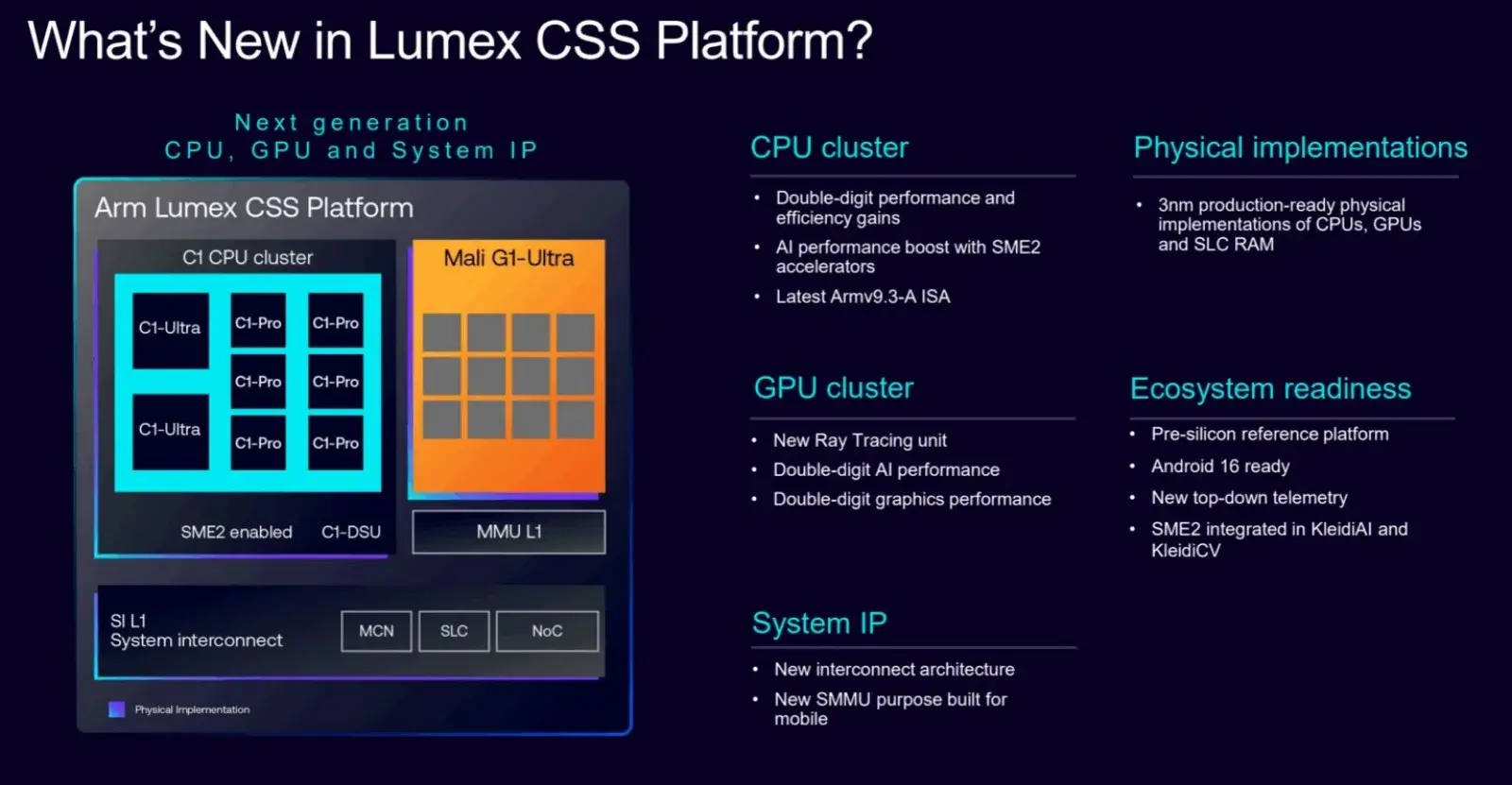

ARM has presented Lumexits most advanced computing subsystem platform (CSS) to date, designed to accelerate the experiences of In the device, both in the high -end android mobiles in the next computers with ARM processors. More than a simple nucleus, Lumex integrates CPU, GPU, interconnection and an optimized software stack, so that manufacturers can reduce Development times and accelerate the launch of its 3 Nm.
The announcement comes at a key moment for the market: users already expect real -time translation, contextual assistants and multimedia edition with ia that work Without depending on the cloud. Lumex intends to respond to that jump by combining new CPU ARM C1 with SME2 extensions To accelerate AI, a GPU Mali G1-Ultra with double performance in ray layout and efficiency improvements, and libraries such as Kleidiai Integrated in the most popular frameworks.
What exactly is Arm Lmex and why matters
Lumex is a “Subsystem” ready to manufacture in 3 Nm nodesthat ARM partners can adopt as is (with already optimized physical implementations) or Configure to measure For different segments. The proposal changes the traditional rhythm of the sector: less ad hoc integration and more high-level blocks ready for the tape-out, with the aim of shortening cycles and ensuring high performance from the first lot.
Another relevant change is the New name scheme. ARM leaves behind the historical brand «Cortex» in mobiles for your family C1 of CPU (with variants C1-Ultra, C1-Premium, C1-Pro and C1-Nano) and renew your GPU with the series Mali G1 (G1-Ultra, G1-Premium and G1-Pro). The novelty is not just aesthetics: the C1 integrate Scalable Matrix Extension 2 (SME2) At the Architecture level ARMV9.3 to multiply performance in loads of AI and scientific computing.
AI, gaming and efficiency performance: keys
He ARM C1 Cluster With Sme2 promises up to 5 times more yield in AI and up to 3 times better efficiency in front of the cluster prior to tasks in voice recognition, audio generation, computer vision or inference of generative models. In practice, this translates into lower latencies, faster responses and experiences of “in real time” They don't drain the battery so quickly.
In the graphic section, The Mali G1-Ultra GPU Enter the Ryv2 ray layout unit and offers Double performance in ray layout in front of the previous generation, in addition to 20 % more in AI/Automatic Learning (ML) In the GPU itself thanks to new FP16 data routes. ARM anticipates more stable frame rates and tangible improvements in games that already use lightning layout on the mobile, in addition to tasks such as superresolution, segmentation or improvement of HDR directly in the terminal.
The other Pilar de Lumex is software. ARM drives Kleidiai and SME2 support in Execatorch (Pytorch), Onnx Runtime, Google Litert and others Frameworksfor developers to take advantage of these capabilities without writing specific code for each soc. For manufacturers, Lumex includes telemetry and profiles ready for Android 16, which should facilitate model optimizations.
What can we expect in Android mobiles

Although there are no official dates, it is foreseeable that the first soc commercials Based on Lumex They arrive with the next generation of flagships and, something later, to the “sub-flagship” segment. The versatility of CPU (of C1-Ultraoriented to large LLMs, to C1-Nanofor wearables) and GPU (from G1-Ultrawith consistent ray layout, until G1-Pro) will allow Lumex to see From the high range to smart watches.
For the user, the impact will be on the functions of the fastest premises and in mobile games with lighting and more realistic reflexes Without sacrificing autonomy.
Technical file
- Manufacturing node: Optimized for 3 nm (physical implementations available to accelerate the “tape-out”).
- CPU: family ARM C1 (ARMV9.3) with SME2; variants C1-Ultra / C1-Premium / C1-Pro / C1-Nano.
- GPU: Mali G1-Ultra (range top), G1-Premium and G1-Pro; RTUV2 with Double performance in ray layout; IA improvements In FP16.
- AI performance (CPU): up to 5 times more yield and up to 3 times better efficiency in front of the previous generation.
- Software: Kleidiai and SME2 support in Execatorch, Onnx Runtime, Google Litert And more.
- Aim: AI on the device (attendees, translation, vision, audio/image creation) and Gaming with Ray layout more stable.
One more step towards the personal AI on Android
Lumex is not a final processor, but a complete plane for Qualcomm, MediatekSamsung and company Design your next chips with less risk and more speed. If you meet what is promised, we will see Android mobiles with a more useful and private AI: Without connection translations, awareness of the context of the immediate multimedia device and editions. And, at the same time, a Graphic jump that approaches the mobile to the PC experience in compatible titles.
As always, the devil is in the details: real consumption, frequencies, memory bandwidth and adoption by the great sockets of SOC. But the address is clear: CPU and GPU return to the center of the mobile AI scenewith a 3 -N platform ready to climb from Wearables to flagships.


