


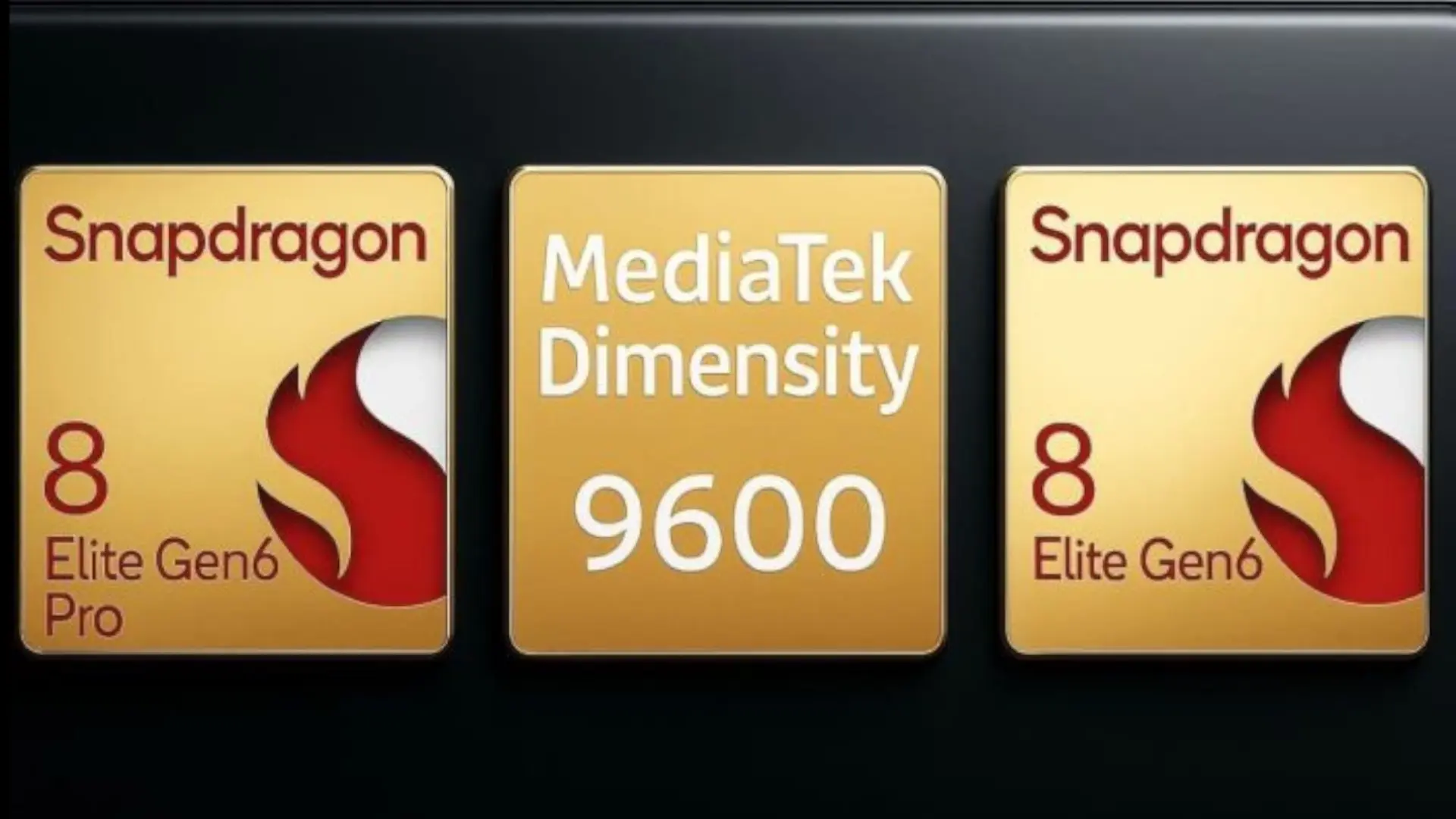

MediaTek is preparing artillery for 2026 and, if the latest rumors are right, the Dimensions 9600 will be located just between the Snapdragon 8 Elite Gen 6 and his Pro version. The leak comes from the well-known informant Digital Chat Station and draws a very specific scenario: Qualcomm would have two variants of its next top of the range, while MediaTek would launch a single system on a chip (SoC) capable of measuring itself with the standard Qualcomm model and making the Pro uncomfortable.
Beyond the position in the table, what is relevant is the process leap: both Qualcomm and MediaTek would bet on TSMC (Taiwan Semiconductor Manufacturing Company) and its 2 nanometer N2P nodea key step to reduce consumption and increase performance. He Dimensions 9600 would keep ARM CPU (central processing unit) and GPU (graphics processing unit)without deep customizations, a strategy that would allow you to optimize costs and arrival times without giving up large figures.
Where the Dimensity 9600 fits on the power map
The hierarchy that is being considered right now is clear: Snapdragon 8 Elite Gen 6 (standard) < Dimensity 9600 < Snapdragon 8 Elite Gen 6 Pro. That is, the new MediaTek chip would aim to surpass the base Qualcomm model, but it would remain one step behind the Pro in graphics and memory. It makes sense if we think that the 8 Elite Gen 6 Pro would add LPDDR6 (Low‑Power Double Data Rate 6) and a more powerful GPU, while the 9600 would focus on a balance between power and efficiency to attract manufacturers that do not need the maximum possible performance for their high ranges.
At the architectural level, Qualcomm expects a 2+3+3 scheme for the CPU with high-performance cores and others aimed at efficiency, plus a redesigned GPU. In the case of MediaTek, everything indicates that the 9600 will continue with the ARM architecture without modifications, unlike Qualcomm, which would be preparing its own core, although it would also benefit from the jump to 2 nanometers N2P, with advantages in density and energy consumption.
Performance, AI and memory: what is intuitive
The use of 2 nanometers should result in notable energy efficiency improvements and scope for frequency scaling. Furthermore, the support of LPDDR6 in Qualcomm's Pro option opens the door to greater bandwidth, something that could make a difference in AI (artificial intelligence) on the device —prompted by NPU (neural processing unit)— and in demanding graphic tasks. He Dimensions 9600 It would not have that latest generation memory card, but it would have an NPU and a ISP (image signal processor) next generation, along with connectivity Wi-Fi 7 and top-level 5G modem, to compete directly in the daily use of the device.
Calendar and which mobile phones could arrive
With the Dimension 9500 Already on the market as a 3 nanometer bet, the 9600 appears on the horizon of end of 2026 if TSMC production times are met. Brands like Vivo, OPPO, OnePlus or Realme have been regular partners of MediaTek in their high-end launches, and it is logical that some of their flagships 2026 adopt this chip as an alternative to the Snapdragon.
A battle that is decided in efficiency
If everything adds up, 2026 will be the year in which high-end Android makes the leap to 2 nanometersand could establish itself as the most balanced option for manufacturers looking for performance without extreme costs: top-level performance, contained consumption and a more competitive cost than that of a Pro with LPDDR6. Do you think MediaTek will be right with this intermediate bet or will manufacturers continue to prefer Qualcomm's top of the range? We read you in the comments.