




Sony moves once again in mobile photography with the LYTIA 901its first sensor for smartphones of approximately 200 megapixels and a size of 1/1.12 inches. We're not just talking about more resolution: the manufacturer combines a large sensor with 0.7 micron pixels, a new Quad-Quad Bayer matrix and image processing with Integrated AI to improve zoom, dynamic range and details even in complicated situations. The goal is that a single main sensor can replace functions that currently require two or three different cameras.
This new LYTIA 901 is a stacked CMOS designed for the high-end, with mass production scheduled for November 2025, so it is expected to arrive on Android phones in 2026. Sony boasts of maintaining very high quality up to a 4x zoom in photo and video, cropping on those 200 MP, using a remosaic engine with automatic learning and several HDR technologies inherited from other LYTIA sensors, like the LYT‑828.
The LYTIA 901 arrives with an optical format of 1/1.12 inch and a resolution of about 200 effective megapixels, grouped under a matrix Quad‑Quad Bayer Coding (QQBC) in which blocks of 16 pixels share the same color filter. In practice, the sensor groups the data from 16 pixels into one, which is equivalent to an effective resolution of 12.5 MP in most situations, adding the information from those 16 pixels to gain sensitivity and reduce noise indoors or at night.
By having a larger area and somewhat larger pixels than the Samsung ISOCELL HP5 200 MPOn paper the LYTIA 901 should capture more light and offer a better balance between detail and dynamic range. Additionally, the stacked architecture allows the pixel layer to be separated from the logic circuit, helping to integrate that Remosaic AI within the sensor itself without significantly increasing energy consumption.
AI, advanced HDR and fast video: what improves your everyday life
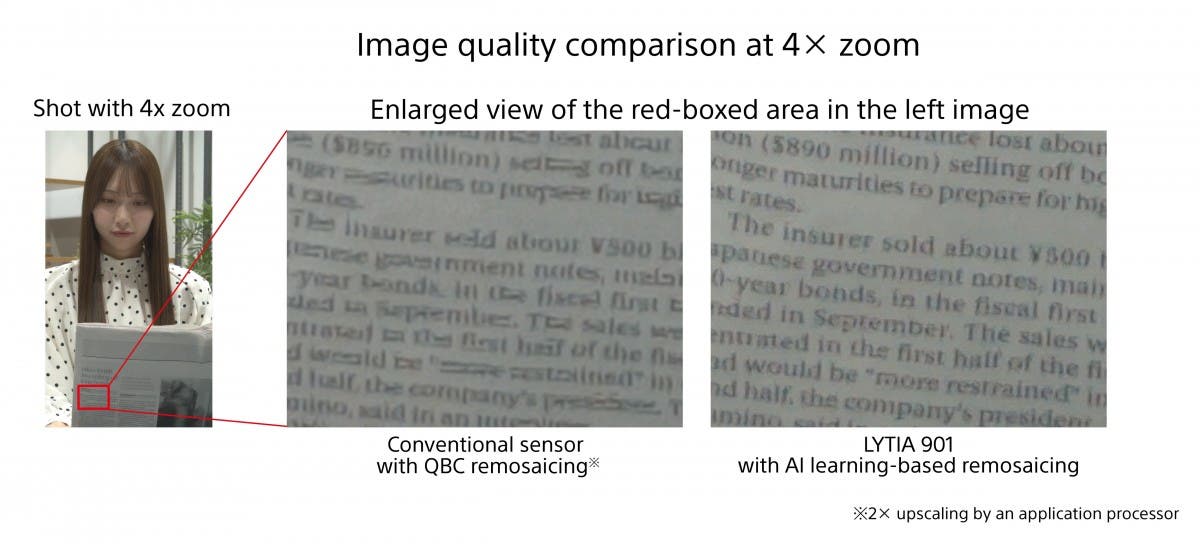
Sony integrates into the LYTIA 901 a remosaic engine based on deep learning that analyzes fine patterns such as text or fabrics to reconstruct detail when we crop the image, especially from the information of those 200 MP. The objective is that a 2x or 4x zoom from main camera Achieve results comparable to a dedicated telephoto lens, without the need for additional modules.
In parallel, the sensor combines several HDR technologies such as DCG‑HDR, Hybrid Frame HDR and conversion 12 bit ADC Fine to exceed 100 dB of dynamic range, reducing burned areas in highlights and loss of detail in shadows. In video, it promises modes as ambitious as 8K at 30 frames per second and 4K at 120 frames per second, maintaining a high-quality 4x zoom also in 4K at 30 fps, which is promising, although it will have to be tested on real devices.
Sony LYTIA 901 technical sheet
- Type: Mobile Stacked CMOS Sensor
- Size: 1/1.12 inch (14.287 mm diagonal)
- Resolution: approximately 200 effective megapixels
- Pixel size: 0.7 × 0.7 microns
- Color matrix: Quad‑Quad Bayer Coding (QQBC, 4×4 binning)
- Integrated AI: remosaic engine with machine learning inside the sensor
- Dynamic range: Over 100 dB with DCG-HDR, HF-HDR and 12-bit ADC conversion
- Video: Up to 200 MP at 10 fps, 50 MP at 30 fps, 12.5 MP at 60 fps, 8K at 30 fps and 4K at 120 fps
- Connectivity: MIPI C‑PHY / D‑PHY interface up to 6.0 Gsps
What phones could release the LYTIA 901 and what we can expect
Although Sony has not confirmed models, leaks suggest that brands such as Vivo or Oppo They will be among the first to adopt this sensor in their high ranges with a focus on photography. It makes a lot of sense: they have already opted for 50 MP LYTIAs before and usually go for the latest in cameras, so a 200 MP sensor capable of offering 4x zoom with minimal loss of quality fits very well into their strategy.
If the promises are kept, we will see Android phones capable of offering better night performance, less noise when zooming and more flexible 4K video without the need for so many different sensors. It remains to be seen how manufacturers manage processing, heating and file size at 200 MP, but at least the LYTIA 901 sets the standard for the next generation to achieve of cameras in high-end mobile phones.