


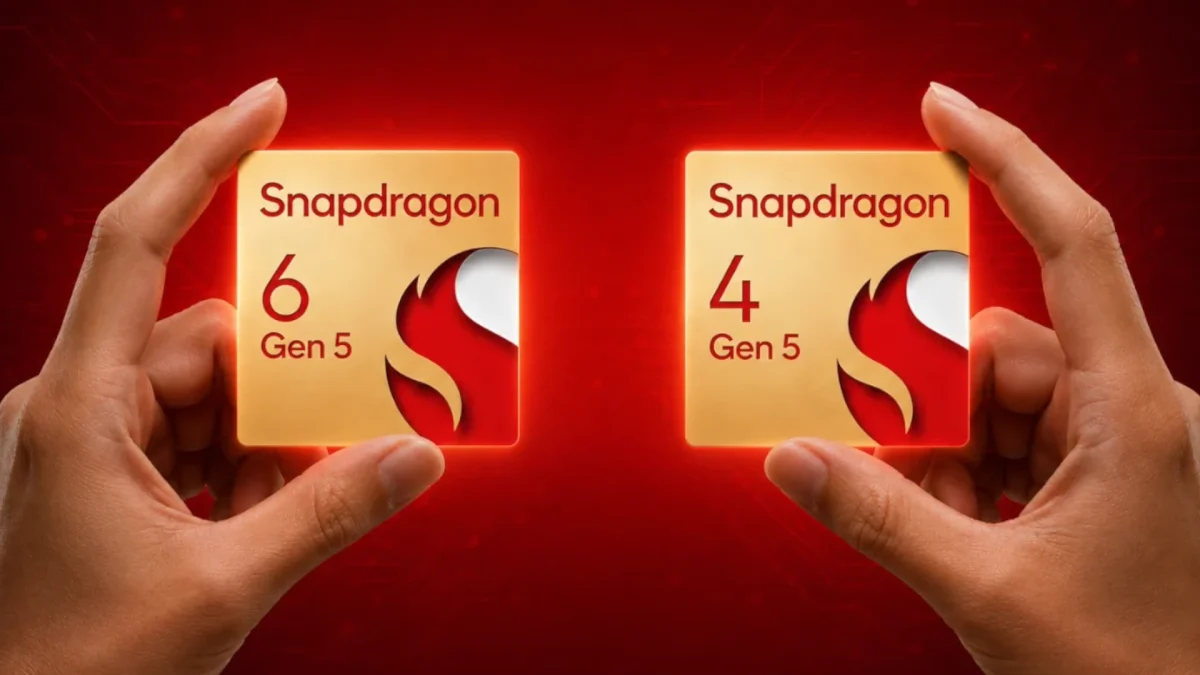

Qualcomm is not stepping on the brakes in 2026 and has just announced the renewal of its most affordable processors. After the launch of its flagship chips for the high-end, the company has decided to focus on budget phones with the new ones Snapdragon 4 Gen 5 and Snapdragon 6 Gen 5. Its main objective on paper is to offer a much more fluid interface, superior performance in games and greater autonomy for day-to-day life.
However, as is usual in this segment, not everything is bright in this advertisement. Although we see obvious improvements thanks to technology Snapdragon Smooth Motion UIQualcomm has made some pretty baffling decisions. There are hardware cuts that could affect the final user experience in key sections such as connectivity or memories, showing that adjusting the price always has consequences.
Snapdragon 4 Gen 5: a graphic leap with questionable decisions
The younger brother of this presentation, the Snapdragon 4 Gen 5promises to give a good injection of power to the entry range with a spectacular 77% increase in the performance of its Adreno GPU compared to the previous generation. This means it will be the first Series 4 chip capable of moving games at 90 frames per second. In addition, its CPU slightly increases the speed to 2.4 GHz, achieving energy savings of 10%.
But here comes the first splash of cold water: Qualcomm has decided to take a step back in RAM. While the previous generation supported fast LPDDR5 memories, this new chip is satisfied only with LPDDR4X. In return, it is comforting to know that it finally integrates video encoding into 4K resolution and support for active dual SIM 5G, although incomprehensibly it maintains outdated connectivities such as Wi-Fi 5.
Snapdragon 4 Gen 5 Technical Data Sheet
- CPU: Octa-core with speeds up to 2.4GHz (achieving 10% more energy efficiency).
- GPU: New generation Adreno with a spectacular increase in 77% in graphic performance.
- Screen: Native support for moving games and the interface up to 90fps (powered by Snapdragon Smooth Motion UI).
- RAM memory: Limited to standard LPDDR4X (speeds up to 2133 MHz).
- Camera: Support for triple ISP configurations for advanced image processing.
- Video: Resolution recording and playback capability 4K.
- Connectivity: 5G with Dual SIM Dual Active support, Wi-Fi 5 and Bluetooth 5.2
Snapdragon 6 Gen 5: lights and shadows in the new mid-range
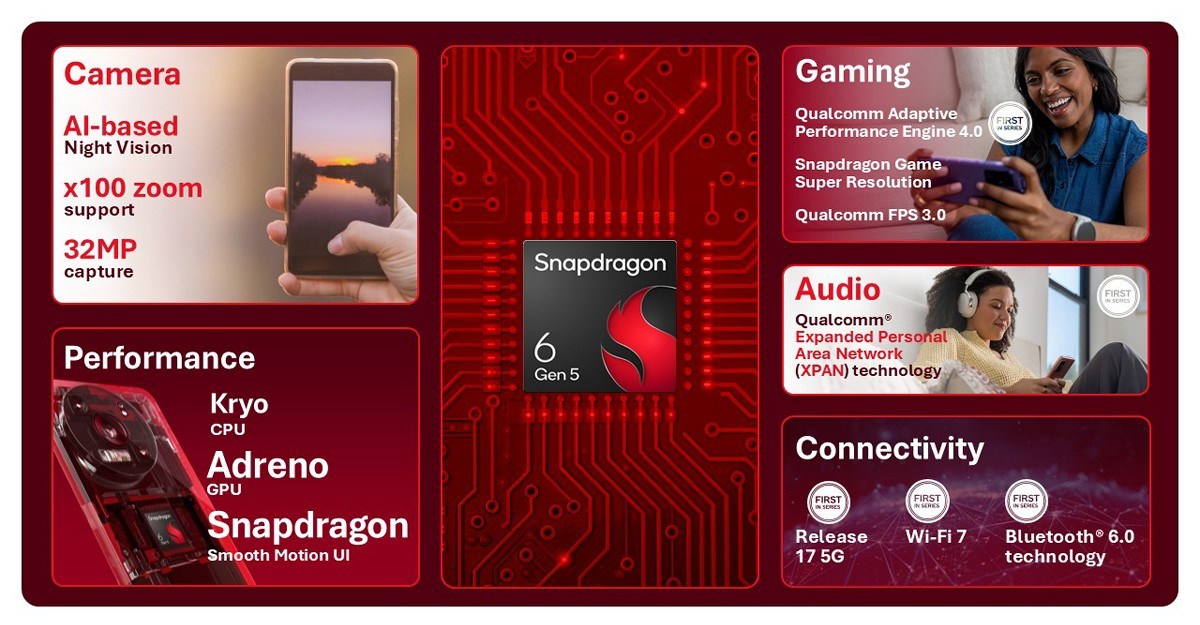
For his part, the Snapdragon 6 Gen 5 comes as the direct evolution of Snapdragon 6 Gen 4 from last year, also manufactured in an efficient 4 nanometer process. This new engine stands out for taking a big leap in its CPU, now integrating four cores that reach 2.6 GHz, compared to the single high-performance core that its predecessor had. Its new Adreno GPU also improves by 21%, supported by adaptive performance engines ideal to avoid crashes. frames in long gaming sessions.
At a photographic level, it is capable of supporting sensors of up to 200 megapixels and includes new AI-powered tools to improve night shots and digital zoom. In addition, it makes the leap to the advanced standard Wi-Fi 7 and Bluetooth 6.0, which guarantees wireless connections at the forefront of today's market.
Unfortunately, Qualcomm's scissors have also passed through here. This processor loses support for mmWave networks, cuts the available GPS bands and, almost inexplicably at this point, lowers the transfer speed to the old one. USB 2.0 standard.
Snapdragon 6 Gen 5 Technical Data Sheet
- Manufacturing process: Built on an efficient architecture 4 nanometers.
- CPU: Jump to 4 high performance cores (reaching 2.6 GHz) combined with 4 efficiency cores.
- GPU: Adreno with an improvement of 21% in performance, supported by adaptive performance engines (Adaptive Performance).
- Photography (ISP): Support for main sensors up to 200MPintegrating new Artificial Intelligence tools for night photography and zoom.
- RAM memory: Support for fast standards LPDDR5 and also LPDDR4X.
- Wireless Connectivity: Leap to the forefront with Wi-Fi 7Bluetooth 6.0 and 5G Sub-6 networks (loses mmWave support).
- Location: GPS limited to bands L1 and L5 (loses band L2).
- Ports and transfer: Speed lowered to old standard USB 2.0.
Despite these striking cuts, brands such as Honor, Oppo, Realme or Redmi are already preparing phones with these chips for the second half of the year. Do you think that the increase in raw power compensates for the cuts in memory and connectivity that Qualcomm has applied in this generation?